

- This event has passed.
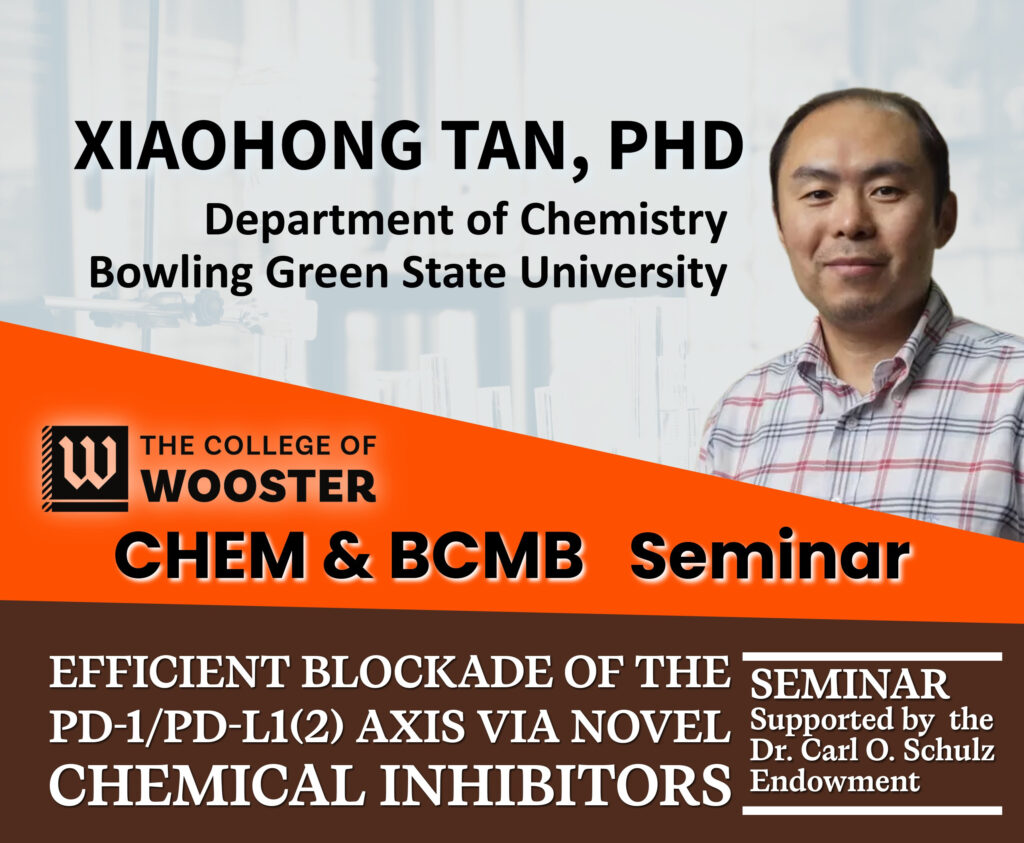
Chemistry & BCMB Seminar
Xiohong Tan, Assistant Professor, Bowling Green State University
March 3 @ 11:00 am – 11:50 am EST
Efficient Blockade of the PD-1/PD-L1(2) Axis via Novel Chemical Inhibitors
Location: Ruth W. Williams Hall of Life Sciences, Room 060
Lunch RSVP: Sign up
Abstract:
Understanding protein–protein interactions (PPIs) is central to deciphering cellular processes, as proteins are the primary functional molecules within cells. Peptides and aptamers, which occupy a strategic niche between antibodies and small molecules, have emerged as powerful tools for probing and modulating PPIs.
Peptides serve as highly versatile ligands, recognizing proteins through hydrogen bonding, van der Waals forces, and ionic interactions. They can be chemically synthesized at low cost, possess low molecular weight, and exhibit enhanced tissue and cellular penetration, making them highly attractive for both research and therapeutic applications. Aptamers, short single-stranded RNA or DNA molecules, fold into unique three-dimensional structures that enable tight, highly specific binding to diverse molecular targets. As compelling alternatives to antibodies, aptamers—especially DNA-based ones—offer long shelf life, low toxicity, minimal immunogenicity, cost-effective chemical synthesis, and broad tolerance for chemical modifications, positioning them as versatile candidates for diagnostics, targeted therapy, and drug development.
In this talk, I will present our recently developed aptamers and peptides targeting the PD-1/PD-L1(2) axis. These novel ligands provide a next-generation strategy for modulating PPIs, opening new avenues for therapeutic intervention and translational applications in immuno-oncology.
Bio:
Dr. Xiaohong Tan earned his Ph.D. from Nanyang Technological University, Singapore. After completing postdoctoral training at the Center for Nucleic Acids Science and Technology at Carnegie Mellon University, USA, he began his independent research career in the Department of Chemistry at Bowling Green State University, USA, where he was promoted to Associate Professor with tenure in 2025. His research expertise encompasses nucleic acid chemistry, peptide chemistry, and protein biochemistry, with a particular focus on developing aptamer- and peptide-based probes for precise protein recognition to investigate protein–protein and protein–nucleic acid interactions. Dr. Tan serves as an Associate Editor for Frontiers in Molecular Biosciences: Molecular Recognition and is a member of the Editorial Board of Scientific Reports. His recent work has been published in leading journals, including Journal of the American Chemical Society, Nature Communications, Theranostics, Analytical Chemistry, Chemical Communications.