
Phi Beta Kappa had a presence on campus long before Wooster obtained a national charter, with the earliest member being Dr. W. Z. Bennett, who started working at Wooster in 1902 or earlier.
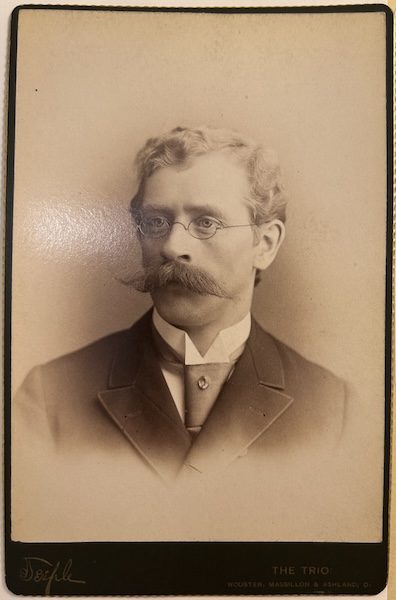
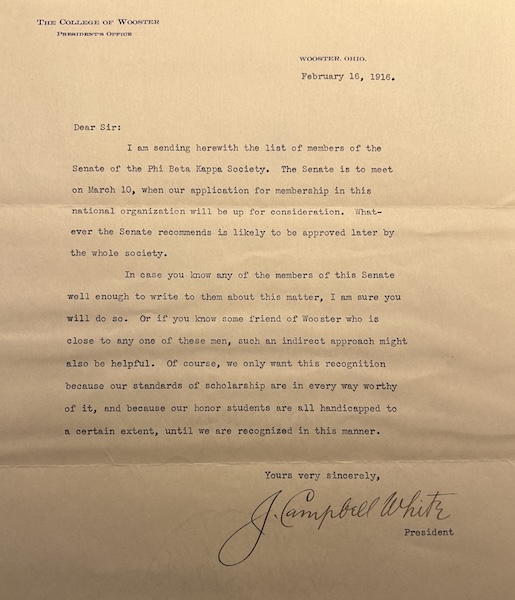
In February 1916, Wooster applies for membership. President White informs a correspondent that he is enclosing the roster of the Phi Beta Kappa Senate, which will review Wooster’s membership application on March 10, and seeks support for the chapter application.
Wooster’s application was initially rejected by PBK, with leadership stating that they found the college unready for a chapter. This decision may have been impacted by division among faculty following the resignation of President Holden and the termination of the Dean of Women, Winona Hughes.
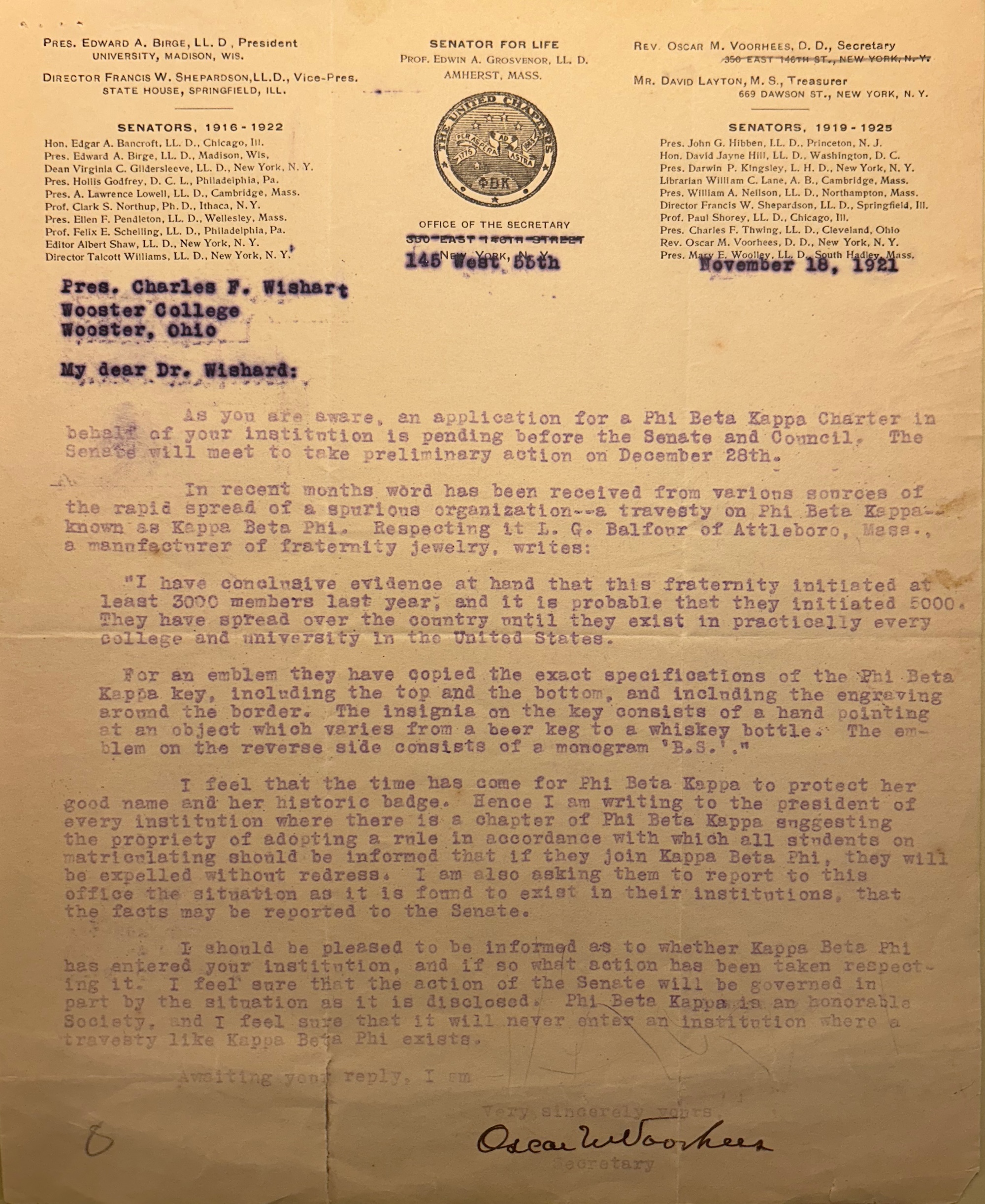
In 1921 Wooster reapplies for a charter. Oscar M. Voorhees, Secretary of the Society sends a letter to President Wishart describing a “rapid spread of a spurious organization – a travesty on Phi Beta Kappa – known as Kappa Beta Phi.”
He continues that “this fraternity initiated at least 3000 members last year.” He requests to know whether Kappa Beta Phi had entered our institution, “and if so what action has been taken respecting it.”
For an emblem they have copied the exact specifications of the Phi Beta Kappa key. The insignia on the key consists of a hand pointing at an object which varies from a beer keg to a whiskey bottle. The emblem on the reverse side consists of a monogram ‘B.S.’”
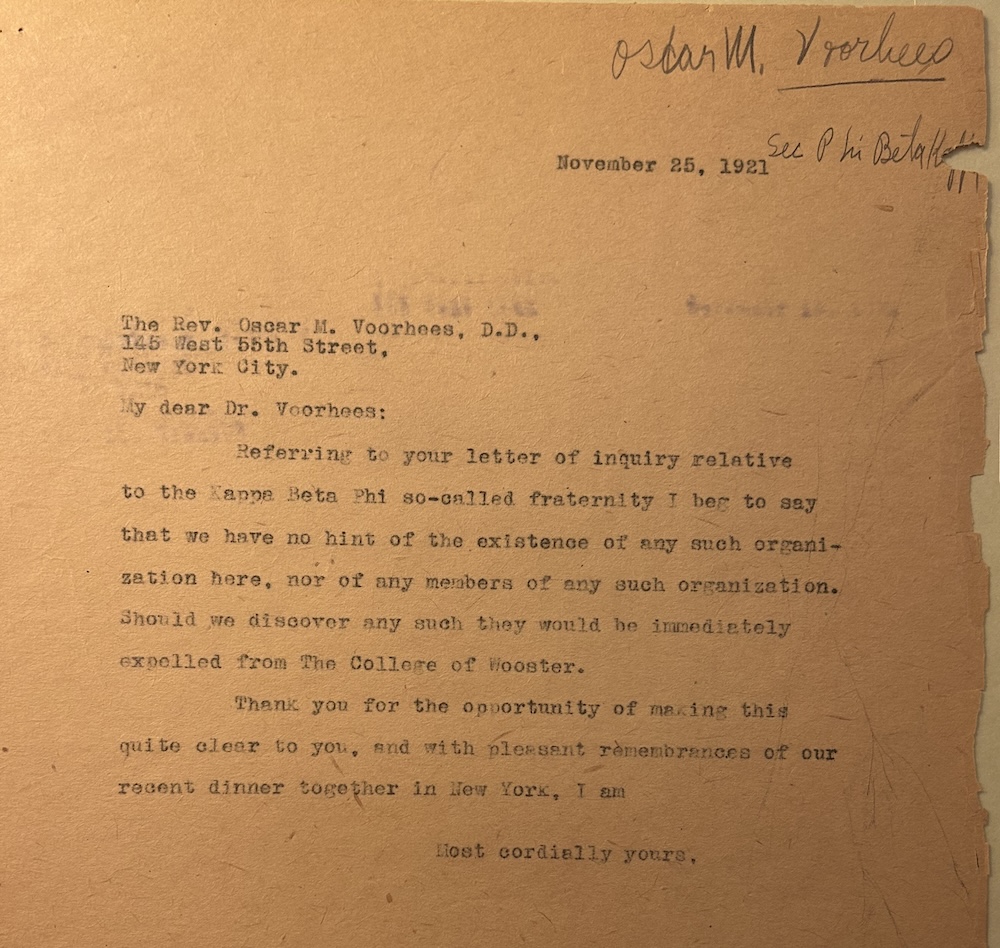
November 25, 1921, President Wishart replies to Secretary Voorhees that no “Kappa Beta Phi” fraternity exists at Wooster and warns that any members discovered would be immediately expelled.
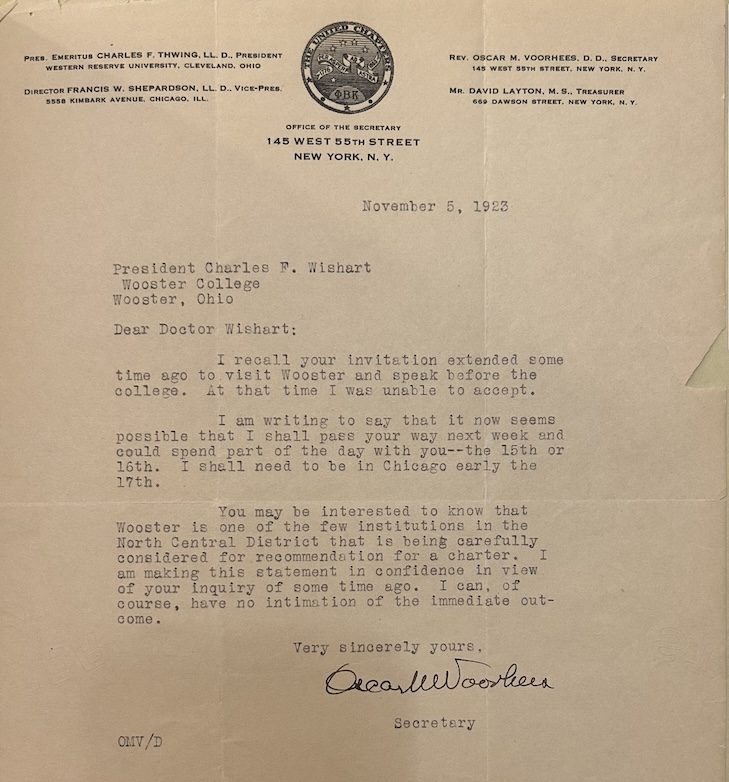
November 5, 1923, Secretary Voorhees writes to President Charles F. Wishart of The College of Wooster to share that he can visit the campus on November 15 or 16 and notes that Wooster is being seriously considered for recommendation for a charter.
The Charter
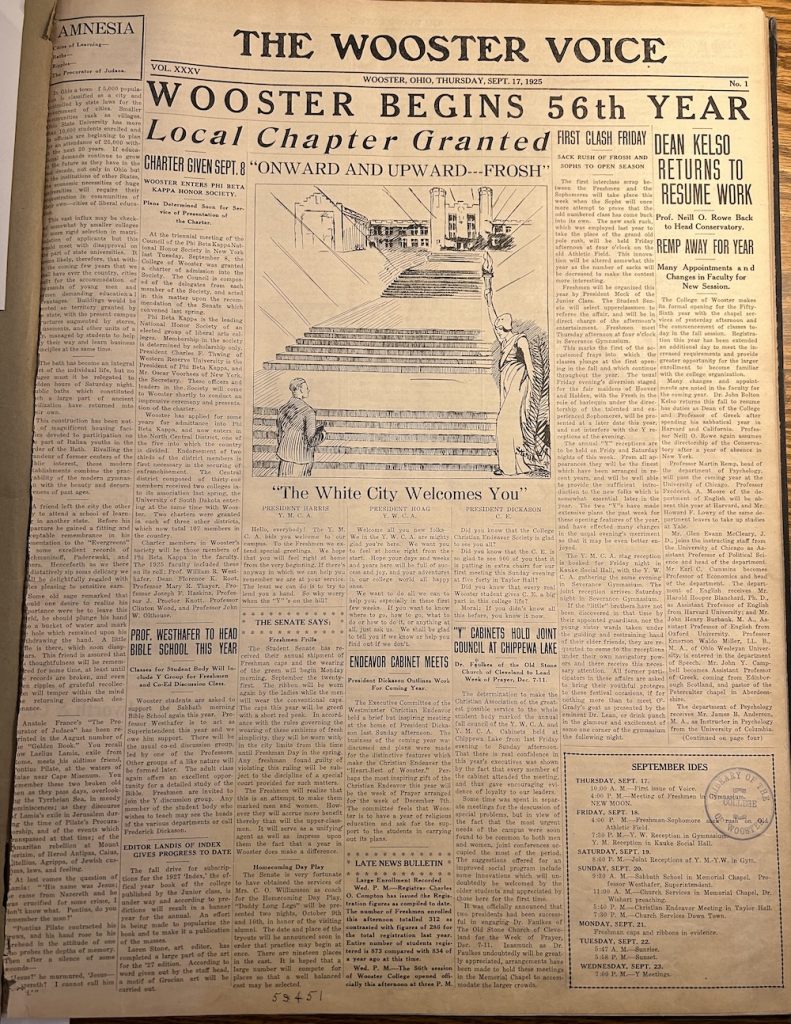
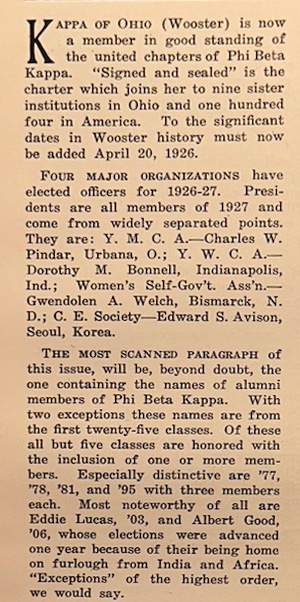
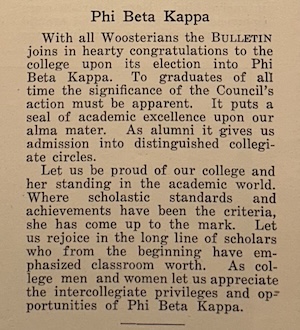
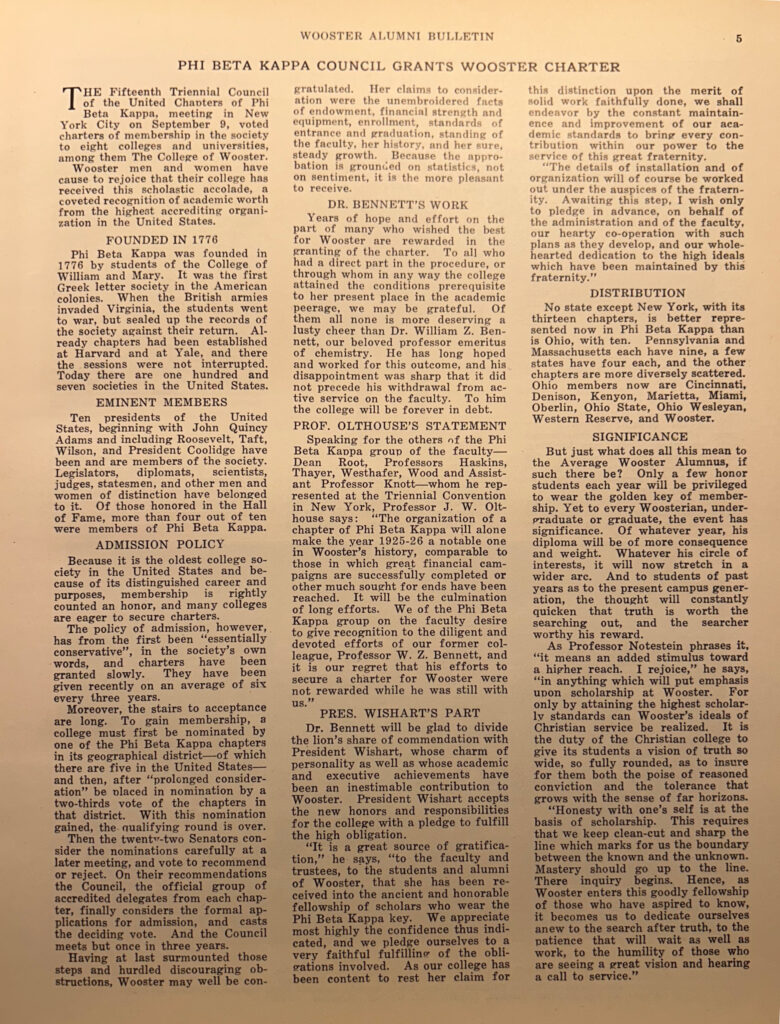
Wooster reapplies for a charter, finally reaching the standard of quality required to have their request granted during the triennial meeting of the Council in September 1925. Wooster became the 105th charter and as the 10th chapter in Ohio was named Kappa of Ohio.
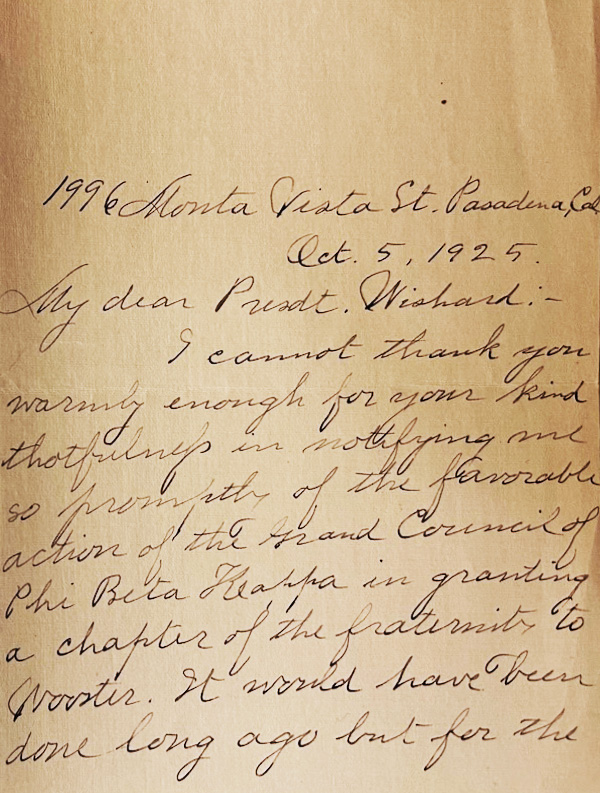
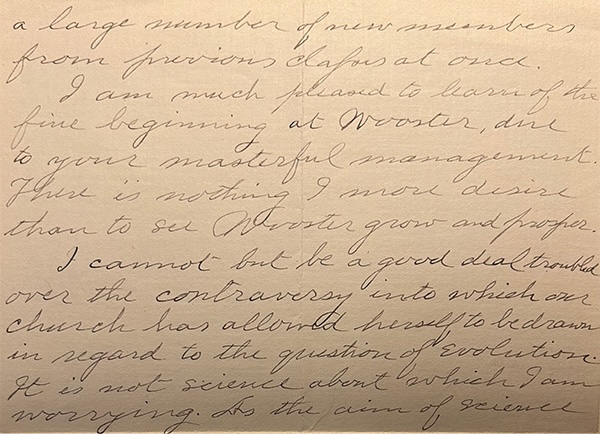
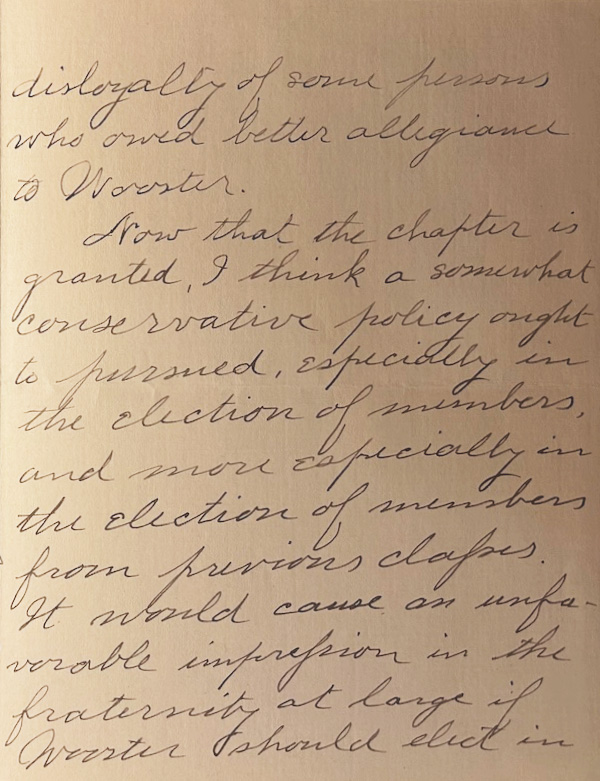
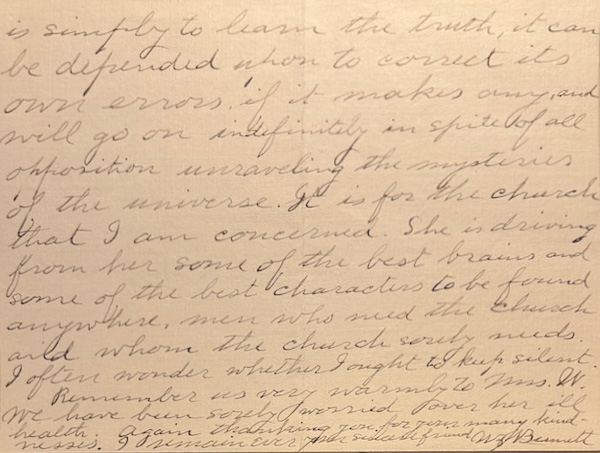
William Z. Bennett writes to President Wishart on Oct. 5, 1925. He thanks him for promptly reporting that Phi Beta Kappa has granted Wooster a chapter and remarks that the honor would have come sooner, “but for the disloyalty of some persons who owed better allegiance to Wooster.” Bennett suggest that Wooster adopt a cautious approach when electing new Phi Beta Kappa members – especially alumni – to avoid unfavorable impressions. He praises President Wishart’s leadership, voices concern that the church’s controversy over evolution is alienating “some of the best brains,” and sends regards to Mrs. Wishart.
The Installation
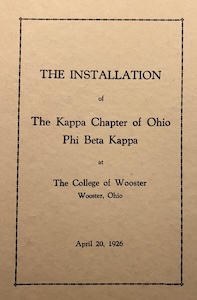
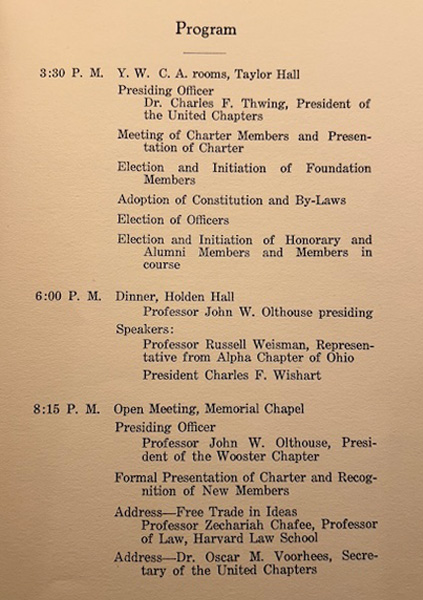
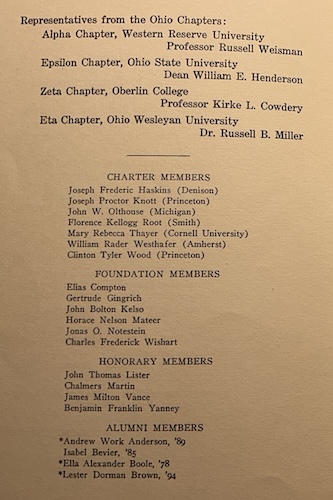
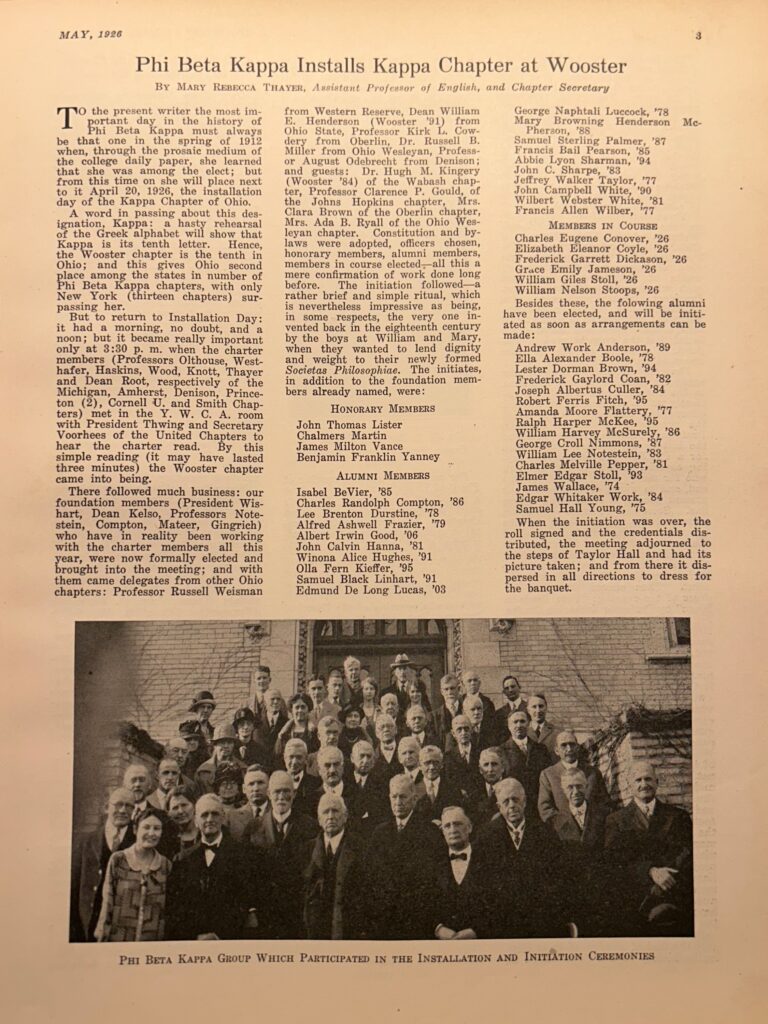
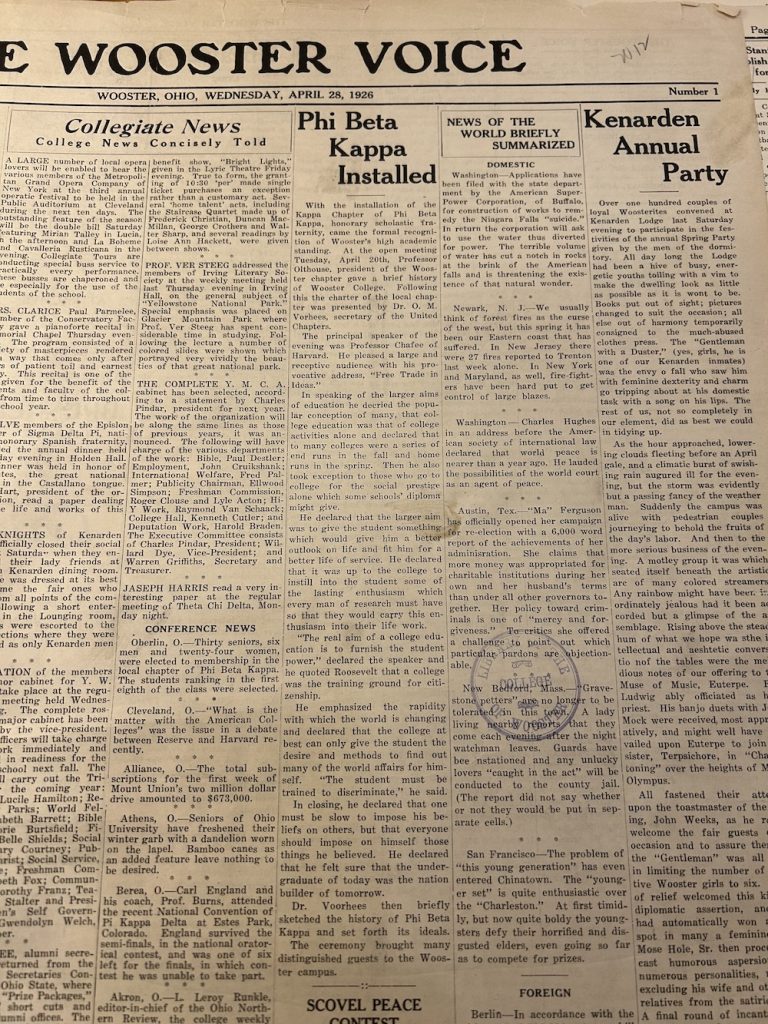
The chapter was officially installed on April 20th of 1926, with an accompanying ceremony and celebration. Dr. Vorhees, Secretary of the United Chapters, presented Wooster with the charter, and the initial members were inducted. In his speech Dr. Vorhees said, “The real aim of college education is to form the student anew.” He declared the college experience as a valuable asset which was the training ground for citizenship.
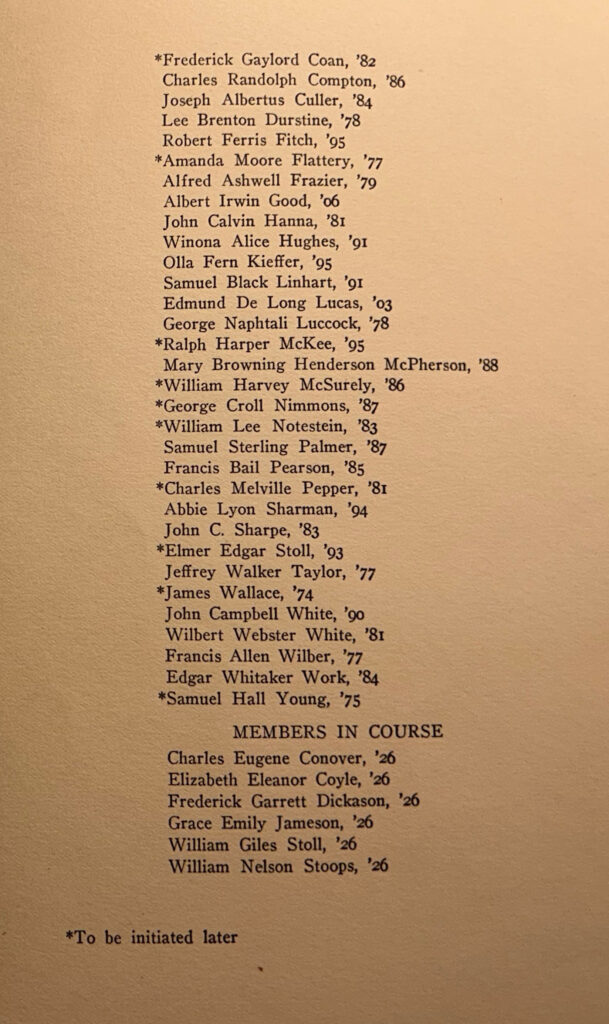
At the first initiation, many alumni members and six seniors were elected.
The chapter’s early leadership included members who are now legendary figures in Wooster’s past: Professors Kelso (Greek), Notestein (Latin), Compton (Philosophy), Mateer (Biology), and Gingrich (German).
The Program for the Installation of The Kappa Chapter of Ohio Phi Beta Kappa at The College of Wooster, Wooster, Ohio, April 20, 1926.
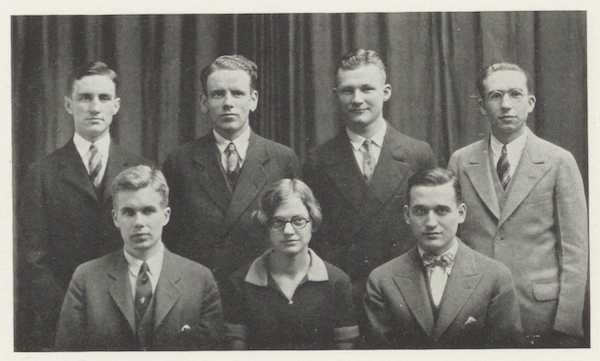
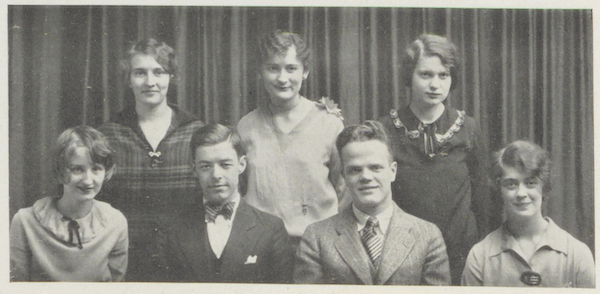
Second row: Martha Stalter, Mary Vail, Eleanor Leech
First row: Lucile Allensworth, Raymond Parshall, Richard Hildner, Mary Strubel
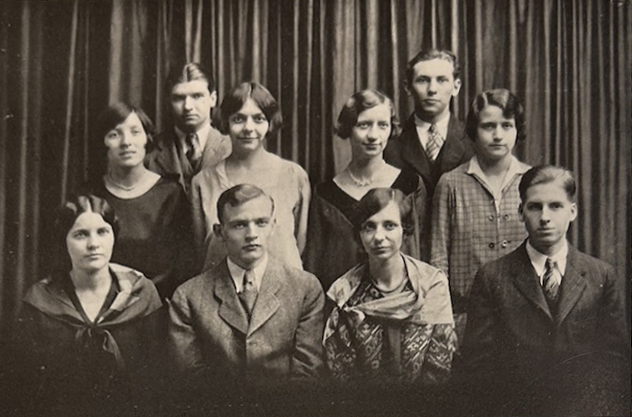
Front row: Catharine Irvin, Marvin Velhurst, Margaret Smith, Arthur Wyse
Back row: Monna Brollier, John Storrie, Dorothy Woodland, Dorothy McCuskey, Edward Wesp, Virginia Myers